
Why men don’t ring.
Everyone says men won’t talk. Someone who works with them told Sydney researchers that’s bullshit.
- 2,425Australian men took their own life in 2025. That’s 73.9% of everyone we lost this way.ABS, 2026
- 79.6%of Norwegian men who took their own life from 2006 to 2015 had seen a GP in their last year.Hauge et al., 2018
- 44.8%of 1,907 Australian men asked about therapy had walked out at some point without telling the therapist.Seidler et al., 2021
The line everyone repeats
Men don’t talk. You’ve seen the poster. In 2019, researchers sat 59 people down in Sydney to ask about it: men, plus people who work with men at health clubs, men’s groups and sports organisations.
“People say men don’t talk, well that’s bullshit, once they’re in the right space you can’t shut them up.”
A stakeholder in Sharp et al., 2022
The men said much the same. One, on training with others: “It’s exercise and not being face to face.” Another, on Men’s Sheds: “there’s a lot of talking about feelings, although they wouldn’t admit to that.”
The words get in the way. The researchers heard that “mental health” itself can put men off, and one group’s answer was to talk about “what is going on in your mind without labelling it”. Mates get in the way too: “I told a mate that I was coming [to a men’s group] and he laughed and I haven’t spoken to him since.”
One city, and mostly men with degrees and good incomes, so it can’t speak for every bloke. It does sink the poster.
Plenty of them already turned up
Norwegian researchers went through primary care records for everyone who took their own life from 2006 to 2015. 79.6% of the men had seen a GP in their last year, 34.8% in their last month. A review of 44 studies found much the same: about 80% in a year and 44% in a month, women and over-50s highest.
Those counts don’t say what anyone came in for, or what got said. They aren’t Australian either: we couldn’t find the same count for Australian men. And this isn’t on any one GP. But the idea that men never turn up doesn’t survive them. Most were in the room.
Not all. Younger men had the lowest contact. In Northern Ireland, 60 of 325 men who took their own life, 18%, had seen no GP or psychiatrist in their last year. The researchers called that “almost exclusively a male issue”, called it “potentially contentious” to treat the GP as the main gatekeeper for these men, and backed building ordinary people’s “capacity to recognise, assess, respond to distress”.
Ordinary people. That’s you and the bloke next door.
Some walked back out
Of the Australian men who left therapy without a word, 54.9% picked one reason: “I didn’t connect with the therapist”. Another 20.2% said it didn’t work or didn’t feel right, 18.0% too expensive or inconvenient. Only 5.5% left because they’d sorted what they came for.
More than one in four men who’d only been once left and hadn’t gone back to any service. The authors say leaving isn’t always a bad thing, and that therapists should raise fit early. Read it the practical way: a bad fit is the commonest reason men leave. It says something about the fit. Trying another one is a fair go.
Self-reliance isn’t what you were told
Australia runs its own long study of men, Ten to Men. In 2017 it looked at 13,884 of them and found one masculine trait stood out: self-reliance, with about a third higher odds of suicidal thinking, even after other factors.
Everyone assumed they knew why. Blokes who do it all themselves don’t ask for help. So researchers tested exactly that on the same study, and published in 2025. Highly self-reliant men again had higher odds, by 46%. Not asking for help explained none of it: an odds ratio of 1.00, which means no effect. The researchers say the reason is still unknown.
One study doesn’t settle it, and it doesn’t show asking is useless. It does show the neat story, stubborn bloke won’t ask, didn’t hold when someone finally checked.
And fixing your own ute was never the fault. A review of nine programs to get men asking found what looked promising: men who’ve been through it, and framing built on what men already value, like responsibility and strength. Nine studies, so suggestive, not proof.
The mate counts
Back to Ten to Men, 7,828 men aged 18 to 60. Men readier to go to a friend or family member were less likely to have new suicidal thoughts. Readiness to see a professional showed no link either way.
It’s a snapshot of what men said they’d do, so it can’t prove cause, and it doesn’t test whether professionals help. Don’t read it as “skip the psychologist”. Read it as: the mate is part of this, on the numbers.
No one reason
None of this comes down to one cause. In the Northern Ireland coroner’s records for those men who saw no one, the reasons given included relationship breakdown, debt and job loss, trauma and shame, and for some, no trigger anyone found. In Australia, the 2025 rate for men in remote areas was 28.0 per 100,000, about double the 14.4 in major cities. No poster covers all that.
So “why don’t men ring” was the wrong question. A better one: who’s standing next to him?
If it’s a mate
Get beside him doing something. The ute, the fence, a walk, training. Skip the words “mental health”. Ask how he’s actually going, then shut up and pass the spanner.
If it’s you
A phone call isn’t the only way in. All of these run around the clock:
- Text Lifeline: 0477 13 11 14
- Ring Lifeline: 13 11 14
- Online chat or video: MensLine or Suicide Call Back Service
“Not great, mate” is plenty to start with. In danger now: 000.
Every number we’ve gotWhere this comes from
- Australian Bureau of Statistics. (2026, October 27). Intentional self-harm (suicide) deaths, 2025. Figures are preliminary. abs.gov.au/statistics/health/causes-death/intentional-self-harm-suicide-deaths/latest-release
- Hauge, L. J., Stene-Larsen, K., Grimholt, T. K., Øien-Ødegaard, C., & Reneflot, A. (2018). Use of primary health care services prior to suicide in the Norwegian population 2006–2015. BMC Health Services Research, 18(1), 619. pubmed.ncbi.nlm.nih.gov/30089524
- Mallon, S., Galway, K., Rondon-Sulbaran, J., Hughes, L., & Leavey, G. (2019). When health services are powerless to prevent suicide: Results from a linkage study of suicide among men with no service contact in the year prior to death. Primary Health Care Research & Development, 20, e80. pmc.ncbi.nlm.nih.gov/articles/PMC8060821
- Pirkis, J., Spittal, M. J., Keogh, L., Mousaferiadis, T., & Currier, D. (2017). Masculinity and suicidal thinking. Social Psychiatry and Psychiatric Epidemiology, 52, 319–327. pubmed.ncbi.nlm.nih.gov/28025691
- Sagar-Ouriaghli, I., Godfrey, E., Bridge, L., Meade, L., & Brown, J. S. L. (2019). Improving mental health service utilization among men: A systematic review and synthesis of behavior change techniques within interventions targeting help-seeking. American Journal of Men’s Health, 13(3), 1557988319857009. pmc.ncbi.nlm.nih.gov/articles/PMC6560805
- Scotti Requena, S., Pirkis, J., Arya, V., Nicholas, A., & Currier, D. (2025). Does help-seeking mediate the relationship between the masculine norm of self-reliance and suicidal thoughts among men? Social Psychiatry and Psychiatric Epidemiology, 60, 1613–1623. pubmed.ncbi.nlm.nih.gov/39527274
- Seidler, Z. E., Wilson, M. J., Kealy, D., Oliffe, J. L., Ogrodniczuk, J. S., & Rice, S. M. (2021). Men’s dropout from mental health services: Results from a survey of Australian men across the life span. American Journal of Men’s Health, 15(3), 15579883211014776. pmc.ncbi.nlm.nih.gov/articles/PMC8165839
- Sharp, P., Bottorff, J. L., Rice, S., Oliffe, J. L., Schulenkorf, N., Impellizzeri, F., & Caperchione, C. M. (2022). “People say men don’t talk, well that’s bullshit”: A focus group study exploring challenges and opportunities for men’s mental health promotion. PLoS ONE, 17(1), e0261997. pmc.ncbi.nlm.nih.gov/articles/PMC8782463
- Stene-Larsen, K., & Reneflot, A. (2019). Contact with primary and mental health care prior to suicide: A systematic review of the literature from 2000 to 2017. Scandinavian Journal of Public Health, 47(1), 9–17. pubmed.ncbi.nlm.nih.gov/29207932
- Tsindos, G., Scurrah, K., Benakovic, R., Reynolds, K. A., & King, K. (2024). Exploring the association between help-seeking intentions and suicidal ideation in Australian adult men. Crisis, 45, 234–241. pubmed.ncbi.nlm.nih.gov/38441130
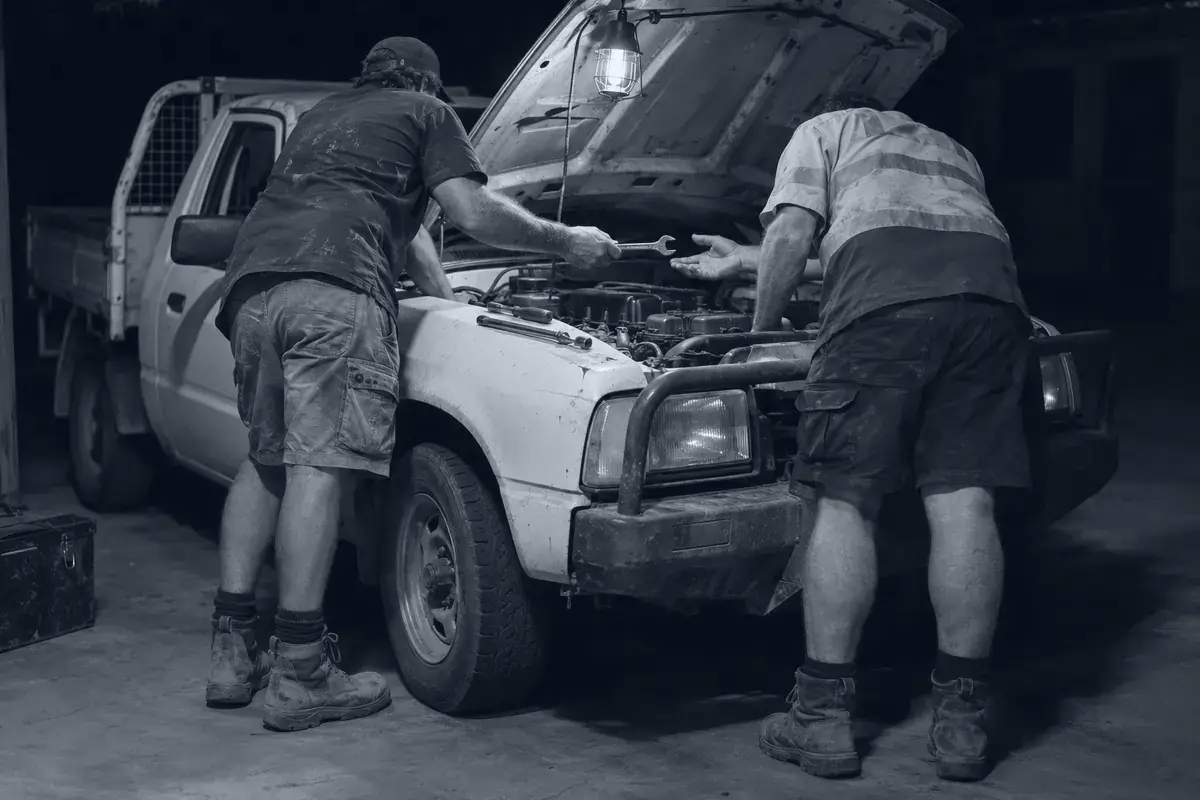
The picture is generated, not real blokes.